Your website traffic is tanking. Your competitors are suddenly dominating page one. And you have no idea why. Here is the truth: AI just rewrote the rules of SEO while you were still playing the old game.
Right now Google is showing AI Overviews for nearly 20% of all searches. ChatGPT is sending thousands of visitors to websites that know how to optimize for it. And traditional SEO tactics that worked last year are failing today.
This guide shows you exactly how to use AI SEO in 2026 to get cited, increase traffic and outperform competitors across Google, ChatGPT and emerging AI platforms.

What Is AI SEO and Why It Matters
AI SEO refers to the use of artificial intelligence technologies to optimize content and strategies for both traditional search engines and emerging AI-powered platforms. But here’s the twist: it’s a two-way street. You’re using AI tools to improve your SEO work, while simultaneously optimizing for AI systems that are reshaping how people search. Think of it as fighting fire with fire. Search engines use sophisticated AI algorithms to rank content, so marketers are turning to AI tools to keep pace with these ever-changing systems.
Using AI for SEO Tasks
Marketers are rapidly adopting AI to handle time-consuming optimization work. According to recent data, 75% of marketers now use AI to reduce time spent on manual tasks like keyword research and meta-tag optimization. The technology is proving its worth, with 52% of SEO professionals reporting performance improvements from using AI for on-page optimization.
AI tools excel at tasks such as analyzing massive datasets to identify keyword opportunities, generating content outlines and drafts, optimizing existing content for target keywords, conducting competitor analysis at scale, and identifying technical SEO issues across websites. The AI SEO software market reflects this growing adoption, with projections showing growth from $1.99 billion in 2024 to $4.97 billion by 2033.
Optimize Content for AI Powered Search Engines
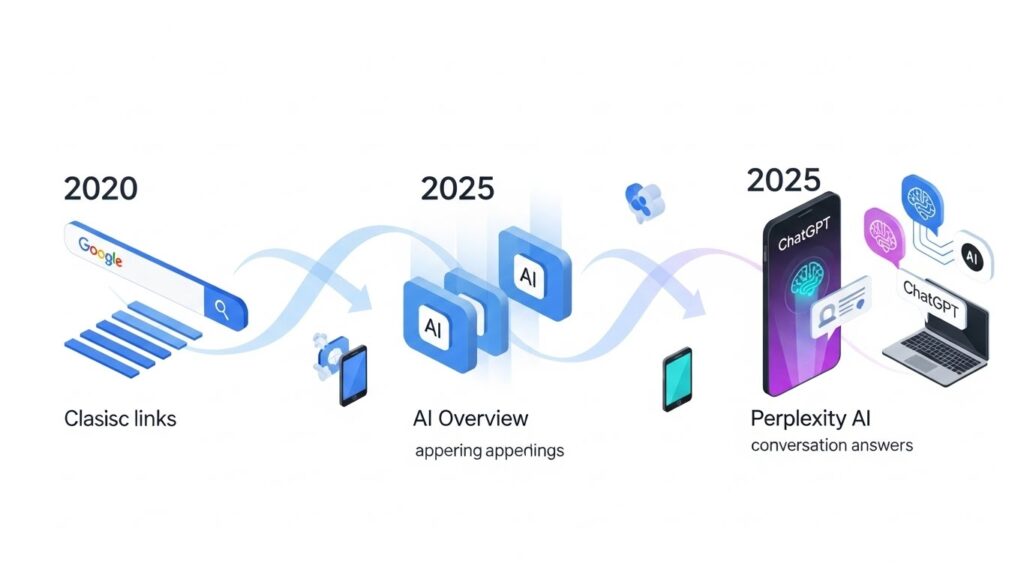
The other side of AI SEO involves adapting your content for AI-driven search experiences. This is where things get interesting and, frankly, a bit nerve-wracking for many marketers. Google’s AI Overviews now appear in approximately 15-20% of searches, pulling information from multiple sources to generate direct answers above traditional search results.
Meanwhile, platforms like ChatGPT, Perplexity, and Gemini are creating entirely new ways for users to discover information. The data tells a compelling story: AI-sourced traffic increased by 527% year-over-year from 2024 to 2025. ChatGPT alone went from 600 visits per month in early 2024 to over 22,000 by May 2025 for some websites.
How AI Changes Keyword Research Strategy
AI has fundamentally changed the keyword research game. Traditional approaches stopped at search volume and competition metrics, but AI-driven tools dive much deeper into understanding user intent and context.
Natural Language Processing Matters for Keywords
AI algorithms now use semantic analysis and predictive modeling to understand the meaning behind search queries, not just the words themselves. This helps identify keywords that align with your audience’s actual interests and needs.
AI identifies patterns Humans Miss
AI tools can uncover keyword opportunities, search trends, and competitor gaps that would take humans weeks to find manually. For instance, tools like Semrush and Ahrefs use AI to analyze search intent, revealing whether users are looking for information, products, or comparisons.
Long Tail Keywords Work Better for AI Search
AI search favors longer, more specific questions. Instead of “running shoes,” users now ask “What are the best running shoes for marathon training with flat feet?” AI keyword research tools help you identify these detailed, intent-driven phrases that convert better.
Query expansion reveals hidden opportunities
AI-powered platforms like AlsoAsked map out related questions from Google’s “People Also Ask” feature, showing you exactly how users expand their queries. This is crucial because AI chatbots use a process called “query fan-out,” breaking complex questions into smaller sub-questions before generating answers.
Best AI SEO Tools for Content Optimization
The AI SEO toolkit has exploded with powerful new platforms. Here are the seven most effective tools based on current market performance and real-world testing:
Semrush AI Visibility Toolkit
Semrush offers comprehensive AI-powered features including keyword research, intent analysis, and the groundbreaking AI Visibility Toolkit that tracks how often your brand appears in AI-generated answers across platforms like ChatGPT and Google AI Mode.
- Best for Marketing teams and agencies and businesses of all sizes
- Pricing Starts at 199 dollars per month
Surfer SEO with Surfer AI
Surfer SEO combines traditional optimization with AI-powered content creation. Surfer AI analyzes top-ranking pages and automatically generates content that includes the right keywords and structure to rank.
- Best for Solopreneurs and small teams automating content creation
- Pricing From 49 dollars per month for Creator
Frase io
Frase combines content research and optimization by analyzing top-ranking pages and user intent. It helps create content briefs and optimizes existing content based on what’s currently working in search results.
- Best for Content marketers focused on intent driven optimization
- Pricing From 15 dollars per month
Jasper AI with SEO Mode
Jasper AI creates SEO-optimized content using natural language processing to weave keywords naturally into copy without disrupting readability. It’s excellent for generating drafts that need human refinement.
- Best for Content creators and copywriters needing AI assistance
- Pricing From 49 dollars per month

Benefits of Using AI for SEO Strategy
AI SEO delivers tangible advantages that can transform your organic search performance. AI SEO helps you work smarter, create better content and reach audiences across multiple discovery channels all while spending less time on tedious manual tasks.
Time Savings on Repetitive SEO Tasks
AI automates keyword research, content optimization, and technical audits that would otherwise consume hours of manual work. Some SEO professionals report reducing their content production time from 8 hours to 2-3 hours per article.
Better Understanding of User Search Intent
AI tools don’t just tell you what keywords people search—they reveal why people search and what they expect to find. This context helps you create content that actually satisfies user needs.
Real Time Performance Tracking Across Platforms
AI-powered analytics provide instant feedback on how your content performs in both traditional search and AI-generated answers. You can quickly identify what’s working and what needs adjustment.
Scalability for Growing Businesses
AI allows small teams to produce optimization work that would typically require large departments. This levels the playing field between small businesses and enterprise competitors.
Improved Content Quality and Relevance
AI analyzes top-performing content and provides specific recommendations on structure, readability, keyword usage, and topic coverage. This ensures your content meets both user expectations and algorithm requirements.
AI SEO Best Practices That Help You Outrank Competitors
Follow these proven best practices to gain a competitive edge.AI can’t fix broken fundamentals. Ensure your website has clean technical SEO, fast loading speeds, mobile optimization, proper indexing, and a logical site structure. AI optimization builds on this foundation.
Focus on E-E-A-T (Experience, Expertise, Authority, Trust)
AI systems heavily prioritize authoritative sources. Demonstrate expertise through first-party research, expert author bios, citations from trusted sources, comprehensive coverage of topics, and schema markup that validates your credentials.
Create Content for Humans, Optimize for AI
Write naturally and conversationally, addressing real questions your audience asks. Then layer in AI optimization by using clear headers, bullet points for key information, structured data markup, and concise summaries at the beginning and end of content.
Optimize for Conversational and Long-Tail Queries
AI search favors detailed, specific questions. Structure your content to answer questions like “What’s the best approach to…” or “How do I choose between…” Include FAQ sections that mirror how people naturally ask questions.
Use Structured Data
Schema markup is no longer optional it’s foundational for AI visibility. Implement relevant schema types for articles, products, FAQs, how-tos, and local businesses. This makes your content machine-readable and increases citation chances.
Make Your Content “Snippable”
AI systems extract and repurpose concise pieces of content. Write self-contained sentences that can stand alone, use bullet points for steps and lists, and provide clear, direct answers in the first sentences of paragraphs.
Build Brand Authority Across Platforms
AI models learn associations between brands and topics. Consistently create content where you have genuine expertise, earn mentions in qualified media, participate in industry forums (Reddit, Quora), and build relationships with authoritative sites in your niche.
Monitor AI Visibility Metrics
Track how often your brand appears in AI answers using tools like Semrush AI Visibility Toolkit, Rank Prompt, or Conductor. Identify which content gets cited and which topics need improvement.
Test and Iterate Regularly
AI platforms change rapidly. What works today might not work in three months. Continuously test different content approaches, monitor performance across multiple AI platforms (ChatGPT, Perplexity, Google AI Mode), and adjust based on actual results.
Avoid Over-Reliance on AI Content Generation
AI can draft content, but human expertise makes it valuable. Always review, fact-check, and enhance AI-generated content with personal insights, original research, and your unique perspective. Content that’s obviously AI-generated performs poorly.
Prioritize Content Quality Over Quantity One exceptional, well-researched article beats ten mediocre AI-generated posts. Focus on depth, originality, and usefulness rather than churning out volume.
Diversify Your Search Strategy
Don’t optimize solely for Google. Consider visibility in traditional search, AI Overviews and featured snippets, ChatGPT and other AI chatbots, and social platforms where search is growing (Reddit, TikTok)
How to Implement AI SEO in Your Marketing Strategy
- Audit Current SEO Performance – Use Google Search Console, Screaming Frog, or current SEO tools.
- Choose AI SEO Tools – Surfer SEO, Frase, or Semrush depending on needs.
- Integrate AI in Keyword Research – Analyze intent, discover long-tail and question-based queries.
- Optimize Existing Content – Add headers, FAQs, structured data, and summaries.
- Create New AI-Assisted Content – Use AI for research and drafting, then refine with human expertise.
- Monitor AI Visibility Metrics – Track citations, AI mentions, and referral traffic.
- Continuous Optimization – Audit monthly, update content, test new formats, refine strategy.
Why Traditional SEO Strategies Need Updates Now
The old playbook was built for Google crawling and indexing cycle. AI platforms operate on a completely different timeline.
Search Is Fracturing Across Multiple Platforms
Users are increasingly turning to AI chatbots for queries requiring contextual and trust heavy and consultative answers. Questions like what should I ask a lawyer before signing this contract are migrating to AI platforms.
Content Consumption Patterns Are Changing
AI Overviews and chatbot responses prioritize concise and factual and well structured information. The content needs to perform inside a model response. Not just on a results page.
Zero Click Searches Are Rising
When AI provides answers directly users may not click through to websites. This is cannibalizing quick fix informational searches while creating more elaborate and deeper queries.
The Current State of AI SEO in 2025
Despite the dramatic shifts Google still processes over 14 billion searches daily. That is a 22% increase from 2024. Search volume is exploding. AI Overviews have stabilized around 15 to 16 percent of searches. Many websites report traffic and conversions remaining steady or even increasing despite the rise of AI features. Why? Because AI Overviews tend to cannibalize simple informational queries while driving more complex and high intent searches that actually convert.
How Different Industries Are Affected by AI SEO
Science and health content sees the highest share of AI Overviews. Legal and finance and health and insurance account for 55% of all AI sourced sessions. E commerce and SaaS are seeing selective but significant growth in AI traffic.
The Future of SEO Is Already Here
AI SEO is about expanding your strategy to account for new discovery channels while doubling down on what has always worked. Creating genuinely helpful and authoritative content.
The marketers who win in 2025 will be the ones building real expertise. Earning genuine trust. Providing value that cannot be replicated by a chatbot.
Search is not dying. It is fracturing. Master this convergence of traditional SEO and AI optimization and you will dominate across Google and ChatGPT and whatever platform emerges next.
FAQs
What is the difference between AI SEO and traditional SEO?
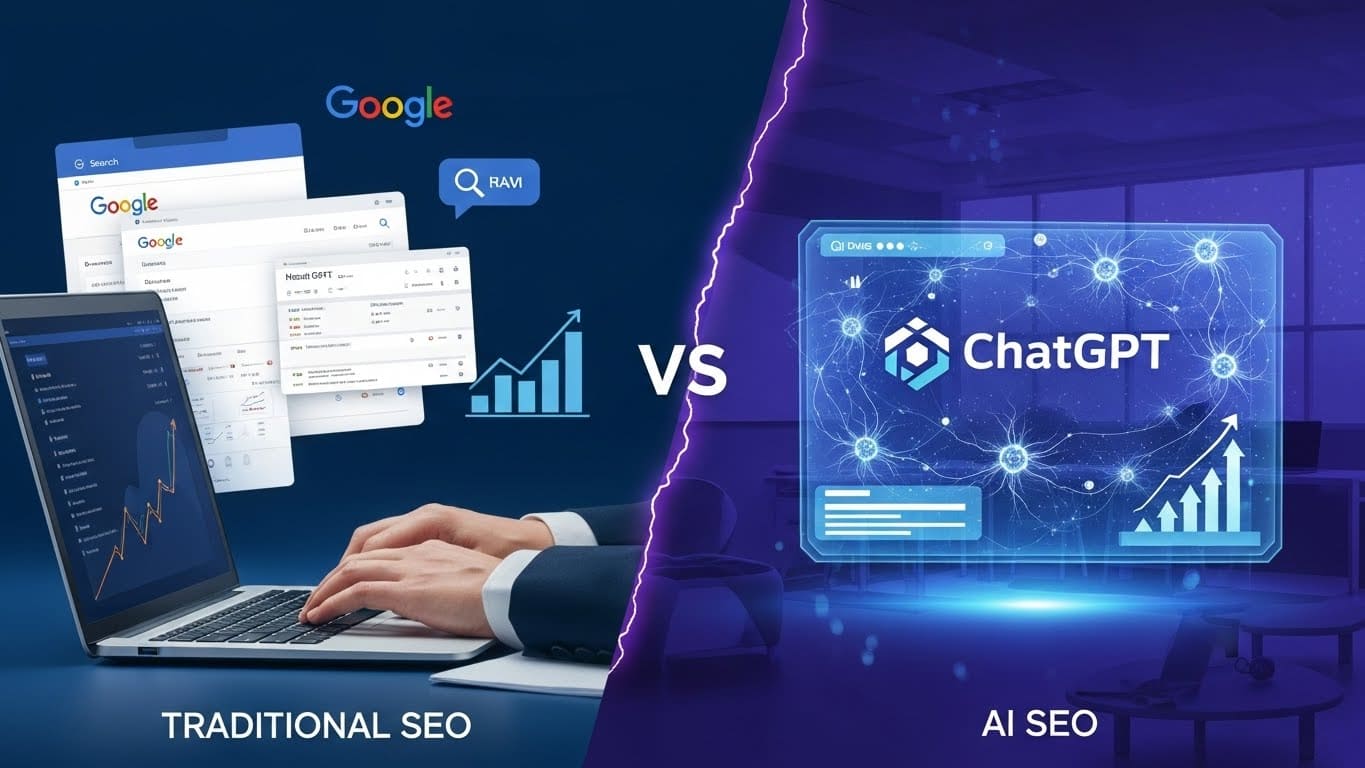
Traditional SEO focuses on ranking pages in search results using keywords, links, and technical optimization. AI SEO goes a step further by optimizing content so it can be understood, summarized, and cited by AI systems like Google AI Overviews, ChatGPT, and Perplexity. Traditional SEO helps you rank. AI SEO helps you get quoted and recommended.
Is AI SEO only useful for large websites and brands?
No. In fact, AI SEO can benefit small websites even more. AI systems often prefer clear, focused, well-structured answers over big brand authority. A small site with strong expertise, clean structure, and direct answers can be cited ahead of larger competitors.
Does AI SEO reduce the importance of backlinks?
Backlinks still matter, but their role is changing. Instead of quantity, AI systems care more about contextual authority. One mention from a trusted source like a niche blog, Reddit thread, or industry site can be more valuable than dozens of low-quality links.
Is AI-generated content bad for AI SEO?
AI-generated content is not automatically bad, but unedited AI content performs poorly. AI systems can detect generic or repetitive writing. Content that includes human insight, real experience, examples, and original opinions performs far better in both rankings and AI summaries.
How long does it take to see results from AI SEO?
AI SEO results can appear faster than traditional SEO in some cases. AI citations and chatbot mentions may happen within weeks if your content is well-structured. However, long-term authority and consistent visibility still take 3 to 6 months of optimization.