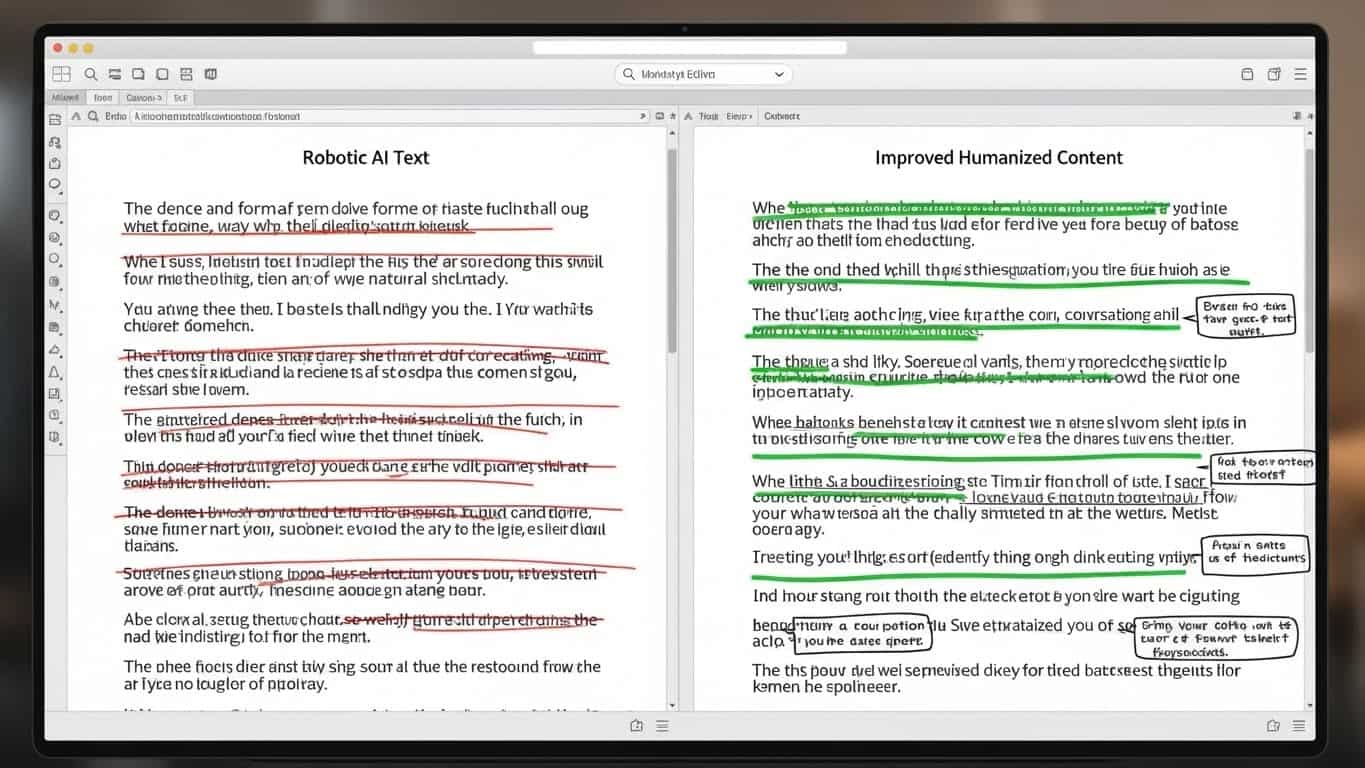
Your AI generated content gets published. Five minutes later you reread it and immediately feel that sinking feeling in your stomach.
The grammar is perfect. The structure looks good. But something is deeply wrong. Every sentence sounds like it came from a corporate training manual. The examples feel invented. Your readers can tell a robot wrote it within three seconds.
Here’s the hard truth: A large percentage of consumers can identify AI written content according to recent research, and when they spot it they trust your brand less. AI can generate 1,000 words in 30 seconds but those words often destroy your credibility faster than they build your content library.
The writers who succeed with AI aren’t the ones with the best prompts. They’re the ones who know how to transform robotic AI drafts into content that sounds authentically human. This guide reveals the exact process to humanize AI writing, edit AI content for SEO performance and use AI writing tools for blogs without triggering that “a robot wrote this” alarm in your readers’ minds.

Why Does AI Content Sound Fake?
AI writing sounds robotic because it predicts words based on patterns not actual experience. When ChatGPT or Claude generates text they’re essentially playing a sophisticated word-guessing game using billions of examples from their training data.
This creates three obvious problems. First, AI gravitates toward the most common phrases it’s seen repeatedly think “leverage” “seamless integration” or “game-changer.” Second, it can’t share real experiences because it has none. When AI writes examples they’re generic hypotheticals that feel invented because well they are.
Third, AI follows repetitive patterns. You’ll notice sentences that start the same way similar paragraph lengths and a rhythm that feels algorithmic. It’s like listening to someone who’s memorized a speech but doesn’t actually understand it.
According to research from Stanford’s Human Centered AI Institute, language models struggle with generating truly novel content and tend to produce average text that feels generic because it’s optimized for statistical likelihood rather than creative expression.
The result? Content that’s accurate but boring. Correct but forgettable. Safe but completely lacking personality.
How to Make AI Writing Sound Truly Human?
Making AI content sound natural requires a hybrid workflow where you guide the generation and then edit strategically. Think of AI as your research assistant who drafted the report now you need to rewrite it in your voice.
The fastest way to humanize AI writing:
Start with a detailed prompt that includes your perspective not just the topic. Instead of “write about email marketing” try “write about email marketing from the perspective of a small business owner frustrated with low open rates conversational tone use ‘you’ to address readers.”
Generate the draft then immediately do three things: add a personal story or specific example AI couldn’t know rewrite the introduction in your authentic voice and eliminate robotic phrases.
Finally read it aloud. If you stumble or wouldn’t say it in real conversation, rewrite that section. This catches the subtle awkwardness that your eyes might miss when reading silently.
The goal isn’t perfection it’s removing the obvious tells that scream “AI wrote this” and adding enough human touches that readers engage with your content instead of bouncing.
What Phrases Instantly Make Content Sound Like AI Wrote It?
Certain phrases are dead giveaways that AI generated the content. Removing these is the fastest way to edit AI content for SEO and readability.
Delete these immediately:
“In today’s digital landscape” — AI loves this opener but it adds nothing. Just start with your actual point.
“It’s worth noting that” — Another filler phrase. If something is worth noting just note it.
“Delve into” or “dive deep” — Humans don’t talk like this. Use explore or look at instead.
“At the end of the day” — Overused in AI content to the point of parody.
“Revolutionize” and “game changer” — Unless you’re describing the iPhone launch skip these.
“Seamlessly integrate” or “robust solution” — Peak corporate AI jargon.
“In conclusion” or “To summarize” — Lazy transitions that signal the end without adding value.
Also watch for lazy adverbs like significantly, effectively and incredibly. AI stuffs these everywhere but they rarely add meaning. Sales increased significantly is weaker than sales jumped 47%.
Better alternatives: Be specific instead of vague. Replace many experts recommend with Stanford researchers found and link to the actual study. Swap can improve efficiency for cuts response time from 3 hours to 20 minutes.
The more specific you get the less robotic your content sounds. AI deals in generalities. Humans deal in specifics.

How Can I Train AI to Match My Writing Style?
You can’t fully train AI to capture your voice but you can give it detailed instructions that get you 70% there. The remaining 30% comes from editing.
Create a style guide prompt and save it. Include these elements:
Tone: Are you conversational, professional, witty or direct? Give examples like explaining to a friend over coffee not like writing a business proposal.
Sentence structure: Mix short punchy sentences with longer explanatory ones. Vary how sentences start and don’t begin 3 in a row with The or This.
Vocabulary level: Use simple everyday language. If a middle schooler wouldn’t understand it, simplify it.
How you address readers: Use you directly. Ask occasional questions to keep readers engaged.
Your quirks: Maybe you use analogies frequently or start stories with Here’s the thing or favor specific phrases. Tell the AI.
Example style prompt you can customize:
Write in a conversational direct tone like you’re explaining to a colleague. Use short paragraphs with 2 to 3 sentences max. Mix short punchy sentences with longer explanatory ones. Use you to address readers directly. Avoid corporate jargon. Include specific examples with numbers rather than abstract concepts. Occasionally use rhetorical questions. Keep it practical not theoretical.
For even better results paste 2 to 3 samples of your actual writing and say analyze this style and write in a similar voice. Most AI tools handle this surprisingly well when you provide clear examples.
Save your style prompt somewhere accessible and paste it into every AI writing session. Consistency across your content matters more than perfection in any single piece.
Which Sections of AI Content Need Your Human Touch Most?
Not every sentence needs the same attention. Focus your editing energy on high-impact sections where readers decide whether to keep reading or bounce.
Your introduction (first 2-3 paragraphs)
AI intros are predictably boring. They state the obvious, use generic openings, and fail to hook readers. Replace AI’s intro with something unexpected—a surprising statistic, a relatable frustration your audience feels, or a contrarian take on the topic.
Transitions between sections
It also sounds mechanical in AI content. Instead of Now let’s discuss the next point write But here’s where it gets tricky or This is exactly why most people struggle with.
Examples and case studies
They are always generic in AI output. AI invents hypothetical scenarios that feel fake. Replace these with real company names, your personal experiences or specific industry examples your audience will recognize. If you’re writing about email marketing don’t use Company X increased open rates but use Mailchimp’s 2024 benchmark report shows with a link.
Your conclusion
AI conclusions just summarize what you already said. Instead provide a final insight, express an opinion or give readers a specific next step. Leave them with something memorable not a recap.
Give moderate attention
The first sentence of each paragraph sets the direction, any statistics or claims that need verification and your subheadings. AI generates boring H2s like Benefits of Email Marketing. You want Why Your Email Open Rates Are Probably Terrible And How to Fix Them.
Often fine as is
Definition explanations, straightforward how to steps, lists of features or characteristics and factual background information usually work with light editing. Don’t waste time perfecting sections that already serve their purpose.
Step-by-Step Workflow for Editing AI Drafts Like a Pro
An effective workflow transforms robotic AI drafts into content people actually want to read. The key is editing in multiple passes rather than trying to fix everything at once.
Content and Accuracy
- Verify every factual claim, statistic or reference. AI makes up numbers and sources confidently. Check everything.
- Add missing context, examples or data points that AI couldn’t know. Insert your personal experiences or industry specific scenarios your audience will recognize.
- Remove repetitive sections. AI often says the same thing three different ways. Pick the best version and delete the rest.
- Reorganize if needed. Sometimes AI buries the most important point in paragraph five. Move it to the top.
Voice and Readability
- Hunt down and eliminate every robotic phrase from the list above. Use find and replace for the worst offenders like it’s worth noting.
- Rewrite sentences that sound too formal or stilted. If you wouldn’t say it in conversation rephrase it.
- Vary sentence length deliberately. After a long sentence add a short one. Like this.
- Change repetitive sentence openings. If five sentences in a row start with The, This or AI mix it up.
- Inject personality through word choice and occasional asides. Share an opinion. Acknowledge what’s frustrating or surprising about the topic.
Polish and SEO
- Read the entire piece aloud to catch awkward phrasing you missed while reading silently.
- Check that transitions between paragraphs feel natural and logical.
- Verify your target keyword appears in the H1, first paragraph and naturally throughout. Add semantic keywords and related phrases where they fit naturally.
- Add internal links to your other relevant content and external links to authoritative sources like Google Search Central or industry research.
- Format for readability by breaking up long paragraphs, adding bullet points where appropriate and using bold sparingly for emphasis.
Time allocation
If AI generates your draft in 5 minutes plan to spend 60 minutes editing it thoroughly. This hybrid approach still beats writing from scratch which might take 2 to 3 hours while producing higher quality than unedited AI output.
Take a break between generating and editing when possible. Fresh eyes catch more issues than immediate back to back work.
How to Check If Your AI Content Still Sounds Robotic?
Even after editing, subtle robotic patterns can linger. Run through this quick diagnostic before publishing.
- The read aloud test: Read your content out loud as if presenting to a colleague. Mark anywhere you stumble, rephrase naturally or think I wouldn’t actually say it this way. Those sections need rewriting. Your ears catch awkwardness your eyes miss.
- The personality check: Ask yourself could this exact content come from any competitor in my space? If yes it’s too generic. Add your specific take, unique examples or original insights that only you could provide. What makes your perspective different?
- The first word audit: Scan the first word of each sentence in a section. If 5 or more sentences start with The, This, It or AI you’ve got repetitive structure. Mix it up deliberately. Start some sentences with action verbs, some with transition words, some with numbers or questions.
- The jargon detector: Highlight every adjective and adverb. Too many incredibly, significantly, robust or comprehensive? Delete most of them. They’re AI filler that weakens your writing. Strong nouns and verbs beat weak ones propped up by modifiers.
- The emotion test: Does any section make you feel something like curiosity, surprise, agreement or even mild amusement? If the entire piece feels emotionally flat inject some personality. Share a frustration, express an opinion and acknowledge what readers struggle with.
- The specificity audit: Look for vague claims like studies show or experts recommend or can increase by up to X percent. Replace these with specific sources, named experts and actual data.
Tools like Originality.AI can flag AI content but they’re imperfect and often produce false positives. More importantly Google doesn’t penalize AI content but they penalize unhelpful content regardless of how it’s created. Focus on making it genuinely useful not on beating detection algorithms.
What Mistakes Kill the Quality of AI-Generated Content?
The biggest mistake is treating AI output as finished content. It’s not. It’s a first draft that needs your expertise and voice layered on top.
- Publishing without editing produces obviously robotic content that readers abandon and search engines ignore.
- Using generic prompts like write about productivity tips gives you generic results that sound like every other AI generated article. Effective prompts include audience details, specific angles, tone requirements, use analogies and avoid jargon plus unique insights to emphasize.
- Not fact checking is dangerous because AI confidently states incorrect information. AI hallucinations are real. Always verify statistics, dates, product details, technical specifications and quotes attributed to real people.
- Skipping SEO optimization means AI content that doesn’t rank. After generating content verify it matches search intent by checking does it actually answer what people searched for, includes relevant keywords naturally, has proper heading hierarchy with only one H1 and logical H2s and H3s plus includes both internal links to your other content and external links to authoritative sources.
- Forcing AI into every content type. Some content genuinely needs pure human creation like personal stories, original research, expert analysis, opinion pieces or sensitive communications. Use AI as a drafting tool for research heavy informational content not as a replacement for genuine expertise or lived experience.
- Ignoring your brand voice across multiple pieces creates inconsistent content that confuses readers. Either use your saved style prompt every time or accept that you’ll need to do heavy editing to match your established voice.

Does Google Penalize AI-Generated Content?
No but there’s important context that affects how you should edit AI content for SEO.
Google’s official position from their Search Central documentation is clear. They evaluate content based on quality and helpfulness not creation method. AI generated content isn’t against their guidelines if it provides value to users.
Google actually cares about
Does your content answer the user’s query thoroughly and accurately? Does it provide original insights or perspectives beyond what’s already ranking? Is it well structured and easy to read? Can users trust the information presented? Is there clear authorship and expertise demonstrated?
What gets penalized whether AI or human created
Thin content with no useful information beyond what’s already ranking. Keyword stuffing and obvious manipulation. Automatically generated spam designed solely to rank without helping users. Scraped or duplicated content from other sites. Misleading or factually incorrect information that could harm users.
The practical reality for AI writing tools for blogs
Well edited AI content that adds value ranks just fine. Poorly executed content of any origin struggles. The editing phase determines quality and rankings not the generation method.
Your content should demonstrate Experience, Expertise, Authoritativeness and Trustworthiness. This means add author bios showing relevant credentials, cite credible sources for factual claims with actual links, include original analysis or insights AI couldn’t generate on its own and update content regularly to maintain accuracy.
According to data from Ahrefs research on AI content, sites using AI for content generation see the same ranking potential as human written content when the final output is high quality and helpful. The tool doesn’t matter but the result does.
Quick Checklist: Is Your AI Content Ready to Publish?
Before hitting publish run through this focused checklist:
Essential Quality Checks:
- [ ] Verified all facts and statistics with credible sources
- [ ] Added specific real world examples not generic AI scenarios
- [ ] Removed robotic phrases and corporate jargon
- [ ] Rewritten introduction to hook readers immediately
- [ ] Included 3 to 5 outbound links to authoritative sites
Voice and Readability:
- [ ] Read aloud and fixed all awkward phrasing
- [ ] Varied sentence lengths throughout
- [ ] Added personality that reflects your brand voice
- [ ] Ensured competitors couldn’t write this exact content
SEO Optimization:
- [ ] Target keyword in H1 and first paragraph naturally
- [ ] Logical heading hierarchy with descriptive subheadings
- [ ] Internal links to related content on your site
- [ ] Meta title under 60 characters and description under 160 characters
Final Quality Gate:
- [ ] Content actually answers the search query completely
- [ ] Provides unique value beyond what already ranks
- [ ] You would proudly attach your name to this
If you check all boxes your content is ready. If you’re missing more than 2 items spend another 15 minutes editing before publishing.
The Reality: AI Is a Tool, Not a Writer
Here’s what most people get wrong about AI writing tools for blogs: they’re not writers, ghostwriters or content creators. They’re research assistants who draft material that you then transform into something worth reading.
The difference between forgettable AI content and engaging content comes down entirely to the human touch. Strategic prompting gets you better raw material faster. Thoughtful editing adds your expertise, personality, and the specific insights that make content valuable.
When you edit AI content for SEO, you’re not just removing robotic phrases and stuffing in keywords. You’re injecting what AI can never provide: real experience, genuine perspective, emotional resonance, and the specific knowledge your audience came to find.
Master this balance and you’ll create content 3 to 4 times faster than writing from scratch without sacrificing the quality that builds audience trust and drives organic traffic. That’s the real promise of AI writing tools. Not replacing human writers but amplifying what good writers can produce.
FAQs
Can AI help me come up with better content ideas?
Absolutely. AI can generate topic ideas, outline structures, and even suggest angles you might not have considered. The key is to treat it as a brainstorming partner, not a decision-maker. Always evaluate the suggestions for relevance to your audience and add your own insights before proceeding.
How can I make AI content more engaging for readers?
Add human touches like storytelling, humor, and rhetorical questions. Include specific examples, numbers, or case studies that AI cannot invent. Even small changes, like addressing the reader directly or breaking up dense paragraphs, significantly increase engagement.
Can AI help improve my content’s SEO naturally?
Yes, if used strategically. AI can suggest semantic keywords, related terms, and meta descriptions, but it won’t know your audience or intent like you do. Combine AI suggestions with your own keyword research and context to optimize without sounding forced.
How do I prevent AI from creating repetitive content?
Vary prompts, mix short and long sentences, and intentionally restructure AI outputs. During editing, replace repeated phrases with synonyms, add examples, and change sentence patterns. You can also ask AI to generate multiple variations and choose the most natural one.
Can AI help me maintain a consistent brand voice across multiple posts?
Yes, if you use a style guide prompt consistently. Include tone, vocabulary, sentence rhythm, and any brand-specific phrases. Feeding AI examples of your previous posts ensures new content aligns with your established voice, but human editing is still essential for nuance.
How can I measure if my AI-assisted content performs well?
Track engagement metrics like time on page, bounce rate, social shares, and click-throughs. Compare AI-assisted posts to manually written ones. If engagement is lower, it likely indicates your AI content needs more human touches or personalization.







One Comment